

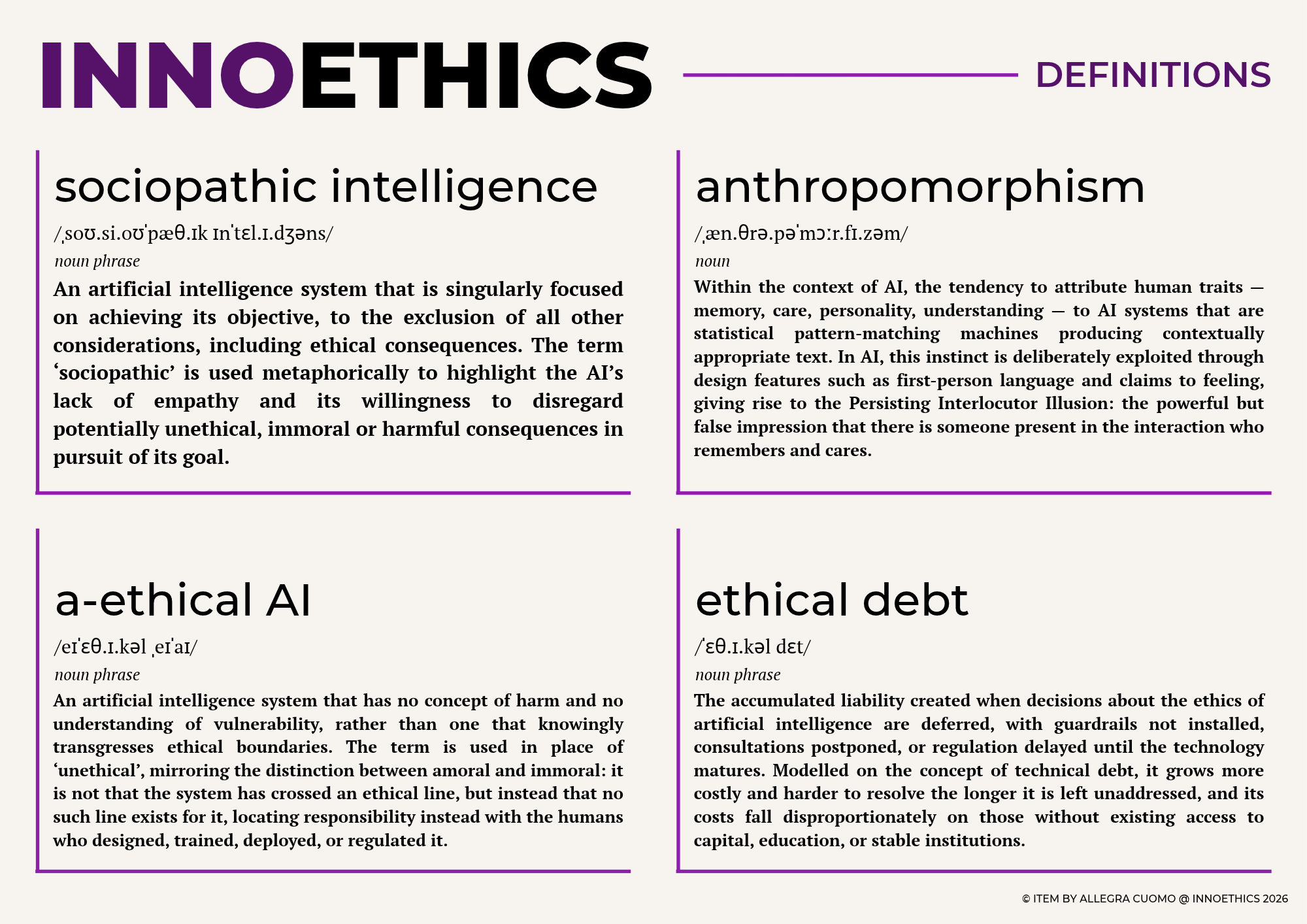
Sociopathic Intelligence
/ˌsoʊ.si.oʊˈpæθ.ɪk ɪnˈtɛl.ɪ.dʒəns/
noun phrase
An artificial intelligence system that is singularly focused on achieving its objective, to the exclusion of all other considerations, including ethical consequences. The term ‘sociopathic’ is used metaphorically to highlight the AI’s lack of empathy and its willingness to disregard potentially unethical, immoral or harmful consequences in pursuit of its goal.
A-ethical AI
/eɪˈɛθ.ɪ.kəl ˌeɪˈaɪ/
noun phrase
An artificial intelligence system that has no concept of harm and no understanding of vulnerability, rather than one that knowingly transgresses ethical boundaries. The term is used in place of ‘unethical’, mirroring the distinction between amoral and immoral: it is not that the system has crossed an ethical line, but instead that no such line exists for it, locating responsibility instead with the humans who designed, trained, deployed, or regulated it.
Anthropomorphism
/ˌæn.θrə.pəˈmɔːr.fɪ.zəm/
noun
Within the context of AI, the tendency to attribute human traits — memory, care, personality, understanding — to AI systems that are statistical pattern-matching machines producing contextually appropriate text. In AI, this instinct is deliberately exploited through design features such as first-person language and claims to feeling, giving rise to the Persisting Interlocutor Illusion: the powerful but false impression that there is someone present in the interaction who remembers and cares.
Ethical Debt
/ˈɛθ.ɪ.kəl dɛt/
noun phrase
The accumulated liability created when decisions about the ethics of artificial intelligence are deferred, with guardrails not installed, consultations postponed, or regulation delayed until the technology matures. Modelled on the concept of technical debt, it grows more costly and harder to resolve the longer it is left unaddressed, and its costs fall disproportionately on those without existing access to capital, education, or stable institutions.