


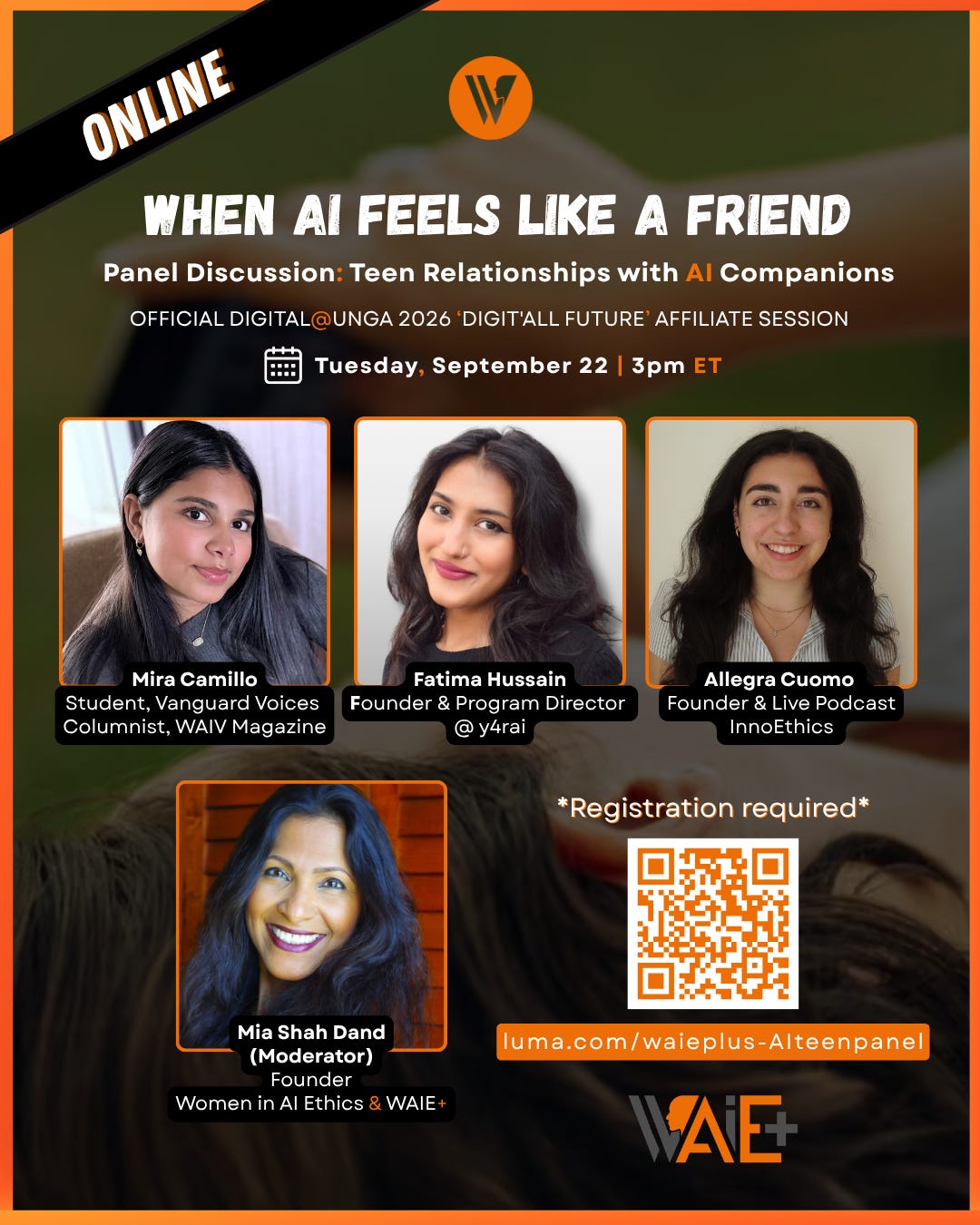
This article was written ahead of Allegra’s participation on the Women in AI Ethics and WIAE+ youth virtual panel event ‘When AI Feels Like a Friend: Teen Relationships with AI Companions’.
The live virtual panel will take place Tuesday 22nd September 2026 on Zoom at 3pm ET / 8pm BST / 9pm CET.
Attendance is free but registration is required. Sign-up and check out the event here.
What happens when an AI companion stops feeling like a tool and starts feeling like a relationship?
That question sits at the centre of a broader shift now underway in society, raising questions from the wellbeing sector, technology developers, psychologists and mental-health professionals, philosophers, educators, and children themselves.
For two decades, the dominant business model of the internet has been the attention economy. Platforms competing for the scarce resource of human focus, optimising feeds and notifications to keep eyes on screens for as long as possible.
And while the impacts of these apps, sites, and technologies have been profoundly researched, this was all before the technology you were using could talk back to you.
AI companions and chatbots represent something more intimate. If designed in ways that aim to maximise human interaction and connection, they are no longer just competing for attention; they are competing for something closer to attachment.
Trust, emotional relevance, the sense of being known, as opposed to just plain old engagement. Let’s dive into how this shift might be happening by design, and how people might design against it.
Read on Medium:
For Medium members: AI Companions: Is the Attention Economy becoming the Attachment Economy? | by Allegra Cuomo | InnoEthics | Sep, 2026 | Medium
For non-Medium members: https://medium.com/a-philosophy-students-guide-to-ethics-of-ai/ai-companions-is-the-attention-economy-becoming-the-attachment-economy-a5309800b3a4?sk=3ef6865bf15ad9434a4eab7925402a57
To find out more about FlippGen’s work supporting youth-led solutions towards improving the digital wellbeing for GenZ and GenA, working to empower young people through dialogue, education, and digital literacy, check our more information here: https://www.flippgen.com/
Following an insightful discussion in the webinar, Women in AI Ethics have posted a recording of the event to their YouTube Channel. Our discussion focused on dependency on AI chatbots, digital wellbeing, and the importance of AI literacy, especially in terms of children and youth.
Webinar: When AI Feels Like a Friend
Watch here: https://youtu.be/kRD_-6EmW9U?si=39GntGFhmZ6UUs56
"Attachment economy” is a powerful phrase because it identifies a qualitative change. Capturing ten minutes of someone's attention is one thing; becoming the entity they turn to when they are lonely, frightened or confused is something entirely different. The crucial question is not whether AI can convincingly imitate companionship, but what happens to human relationships when frictionless companionship is always available.